Showing posts with label Easter Eggs. Show all posts

Sunday, April 05, 2026

Happy Easter - Happy Spring!


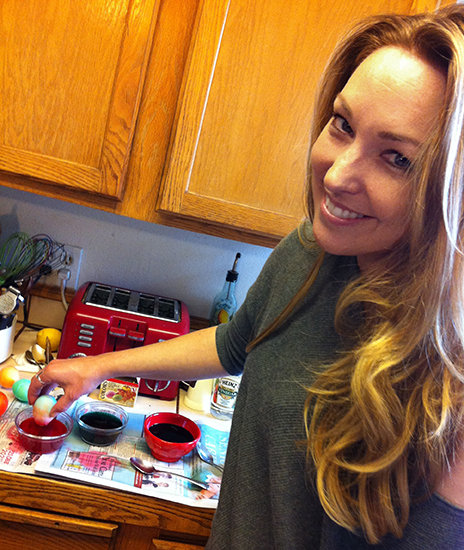
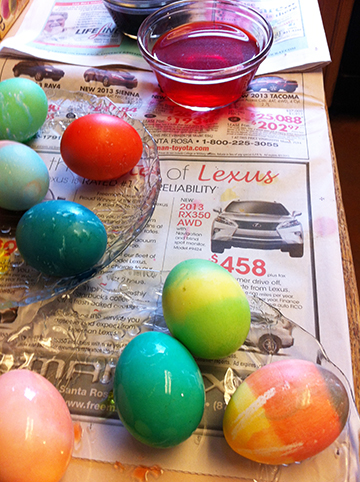
 Doing egg dying the old fashioned way with boiling water, vinegar and food coloring, I made these yesterday. A few went to a friend, Paula, in a sort of Easter basket, and the rest will decorate the table today for lunch with old and cherished friends from Healdsburg. Thought of Dad and how he would decorate eggs long after the 'kids' had left home. Those coming for Easter would often find an egg with their name on it...a resist process using either crayons or wax.

Have a Happy Day!

Wednesday, March 27, 2024

Easter Is Coming!


A number of years ago I posted on how to color Easter eggs the old fashioned way, using boiling water, vinegar and food coloring. It's how we did it when I was growing up and it still works well, especially if you don't have the time or money to spend on the coloring kits you buy at the store. I'm posting it again for this Easter, which will be here this Sunday! 

 This recipe is an easy one to do if you have food colors in your pantry. I used the liquid food colors, so I'm not sure if gel or paste or powdered ones would work for this recipe. I like the fact that you are using traditional food dyes that have been used for a long time rather than some fizzy tablets with who-knows-what chemicals in them. You can also boil onion skins and/or red onion skins, strain the liquid and add that to some vinegar for an even more natural dye.


Dad's Easter Eggs Bring to a boil in cold water as many dozens of eggs as you wish to color.

Once water has come to a boil, simmer for ten minutes. Turn off heat and cool, or turn into a colander and run cold water over until eggs are cool. (Dad used to add a little Borax -- ½ t. probably -- to the water before boiling. It takes some coating off the eggs for better coloring.)

Bring a tea kettle full of water to a boil. Set out one custard cup for each dye color. Place 1 T. cider vinegar into each custard cup. Add 3-4 drops food color to a cup for each color. Fill custard cups half way up with boiling water, and dye eggs. Spoon can be used to lift eggs out of dye bath. We used to write and draw on dry eggs with crayons or plain wax right before we put them into the dye bath.

Store in refrigerator in the cartons the eggs came in. Figure out how to use so-o-o-o many hard boiled eggs!

MOM’S NOTES: Dad loved to do the Easter eggs, just as he loved to prepare for Christmas. Sometimes he would use the fizzy tablets instead of food colors. Even when the children grew up, he would make colored hard boiled eggs with names on them for those who would be visiting at Easter.

If you prefer to have scrambled eggs and egg shells to dye, you can pierce a hole at either end of fresh eggs, blow the contents into a bowl, run some water through the empty shells to rinse them, then dye them in the dye bath like the eggs below. The eggs in the bowl can be turned into fine scrambled eggs.

Wednesday, November 07, 2018

The One With Easter Eggs


I know it's November and by the time that Easter rolls around next spring you will have long forgotten this post, but that's O.K. I'm doing Food Memories all November and Easter Eggs have a long and honored position in those memories.

As a youngster I joined my sisters and brothers around the dining room table to color eggs before Easter. My Mom covered the table with newspapers and there was probably a waterproof sheet under those. We usually made a mess.


The basic concept was to take a hard boiled egg and dip it into a water bath that had been anointed with apple cider vinegar and colored with food coloring drops. Mom would always do the boiling water in the coloring bath until we were old enough to handle that.

The longer that the egg sat in the color bath, the deeper the color became. Still, you couldn't leave it in very long because someone else always wanted to use that color for their egg. A favorite way to identify the eggs you colored was to use a paraffin candle before coloring to draw a design on the egg or write your name. Crayons worked, too.  It's amazing how many lovely eggs can be made just using yellow, red, blue, green and purple dyes. The purples were always a little sickly looking...mixing colors wasn't easy. You can also do a two-toned egg by dipping an egg that has some color into another color halfway, like in the photo below.


Of course once you have all those colored eggs you have to do something with them. Little kids love to hunt for hidden Easter eggs and the colors make them fairly easy to find. Some adults like to hide the eggs even more than finding them. My Dad was one of those and so am I. It really helps to make a firm note of where all the eggs are hidden. I remember one year when I was a did and we thought we had found them all only to discover that there must have been one hidden too well. How did we know? The couch started smelling like rotten eggs. Sure enough. There, in the crevice between the support of the couch cushion and the side arm there was an egg that had wiggled down there (probably due to folks wiggling on the cushions, but then we were a lively bunch!) and was hidden long enough to spoil. Be warned! Make a list of where you hide the eggs.

When my kids were little we did pretty much the same thing as I  had done as a kid, although a few years we tried the fizzy tablets that were sold at the store instead of the vinegar and boiling water and food coloring mixture.


Lately I've been lucky to be able to color eggs with my daughter, although not every year. Some years we do the traditional boiling water-vinegar-food coloring egg baths.


The latest springtime fun is trying new techniques with her. One year we shook the eggs in bags that had raw rice and drops of color. That was a good one. The rice made little darker streaks and dots so the eggs had a very textured look.


Another year we put shaving cream in pie pans and did marbled eggs. Another good one, but I can't find any photos - probably too messy to take photos, but it sure was fun! One year we blew the contents of raw eggs out through a tiny hole in the eggs shell and colored the shells. Very pretty and you can keep them for next year...which we did!


Do you have any favorite way to color eggs for Easter that you'd like to share? It would be fun to try something different next year.

Monday, April 21, 2014

Easter Surprise


My darling daughter had a visitor from out of town over the weekend, so I didn't think we would see her. Imagine my delight when she phoned Easter morning and said she wanted to visit at lunch time. The friend had to fly home in the morning.


We agreed that if I could get some eggs hard cooked in the morning that we would both love to color the eggs. She could take them home to have for lunch at work during the week.


It was a gorgeous day in the mid 70s, with a light breeze. We set up the little dishes with food coloring, vinegar and boiling water out on the deck and had our fun listening to the birds and watching the butterflies flit by. What a wonderful way to spend Easter afternoon.


Hope your weekend was great, too!


Want to learn how to color Easter eggs the old fashioned way? (Even if it is past Easter, eggs are a symbol of Spring and in some places, and you really know this year who you are, it is just barely past winter...a perfect way to celebrate the warming of the weather and coming of the flowers and new leaves...color eggs.

This method uses hard cooked, cooled eggs, food color, vinegar and boiling water...plus some creativity.
Give it a try! The link takes you to step by step directions. Child's play really.


Friday, April 05, 2013

Easter Eggs


I know it is well past Easter, but I just remembered that our daughter came over on Easter for brunch and then we colored Easter eggs. When I mentioned that at the gym, I found that DeeDee and Miss F would have been happy to join us. Next year I'm thinking that I should have a little party to color eggs. No need to be a kid to enjoy the fun of mixing colors, adding designs and generally messing around with dye.


Here are some examples of our eggs. I hard boiled them the day before, so the were cold and a bit damp. Next time I'll warm them up a bit and dry them off. I think that will make for ease when adding colored crayon designs. Having crayons that are newer than 15 year old ones would probably help, too.


Did you color eggs this year? Did you use the fizzy tablets ? Every year I get a lot of hits just before Easter for my many-years-ago post on how to color them the old-fashioned way with vinegar, food coloring, and boiling water. If you usually have food color in your cupboard, this way is much cheaper than using the sets sold in the markets.


You will have to use spoons to lower the eggs into the dye bath and take them out instead of the cool wire holder, but that wire holder usually bends out do shape before you are finished anyway. HERE is the link to the post telling how to do it with vinegar and food colors. As you can see, you can get some brilliant colors this way.


An even older way to dye eggs is with dyes made from things like beets, onion skins, saffron and other natural materials. This is the way to go to avoid the chemicals found in food dyes. Katie from Simple Homemade used beets and other goodies to color eggs and has a great write up telling you how, so go HERE to see how she did that.

Hope you had a happy Easter, if you celebrate it.  XO. Elle

Saturday, April 07, 2012

Easter Egg Bread Loaves

 Since I have a sweet tooth a mile wide I love Easter with the multitude of candies in the stores all ready for the Easter basket. I often make sweet rolls for Easter brunch, too. But not everyone loves all things sweet so this year I'm surprising Grandma Loyce with her own Easter egg, but it is a savory bread egg since she doesn't do sweets.

I started with a bread recipe that uses pumpkin. The recipe started with raw pumpkin but I had a can of processed pumpkin so I used that. I added some garlic since I once made a yam bread that included garlic and it was a great flavor combination so I figured that this bread could profit from a little garlic, too. The pumpkin gave the dough a lovely golden color.

 For the decorations I decided to use a flour and water paste as is sometimes done to make the cross on hot cross buns, but I divided it into two ZipLoc plastic bags. One was flavored with finely minced parsley and colored with a few drops of green food color. The other one was given a shot of catsup and a drop of red food coloring. As you can see in the photos the green kept its color better than the red during baking. Each egg was sliced across toward the top and bottom to give the dough room to expand in the oven. I put a band of the red paste across those, then added a green zig-zag and dots and then some red dots, too. The end result was two colorful loaves that look a bit like colored Easter eggs and smell like the best bread.

I intend to wait until tomorrow to slice up the one I made for Sweetie and me and I look forward to surprising Grandma with her own loaf of colorful Easter cheer. This bread is supposed to make a fine soft bread that toasts well. We will see.

Happy Easter to those who celebrate it!


Savory Easter Eggs
Based on Pumpkin Bread in Flavored Breads by Linda Collister
 14 oz. canned pumpkin puree (Not pumpkin pie filling)
1 tablespoon olive oil
2 1/2 teaspoons sea salt
2 teaspoons sugar
1 packet (about 2.25 oz.) active dry yeast proofed in 1/4 cup lukewarm water
3 cups (more or less) bread flour
extra flour for dusting
1/2 cup flour
water

Mix the pumpkin puree and olive oil in a a large bowl. Mix in the sea salt and sugar. Set aside.

Add the proofed yeast to the pumpkin mixture.

Stir in 1 cup of flour. Let sit 2 minutes. Stir in another cup of flour. Let sit 2 minutes. Stir in enough additional flour to make a shaggy dough. Turn out onto a floured board and knead in additional flour. Dough will be soft but not sticky.

Put into an oiled proofing bowl or container, turning dough over to coat with oil. Set in a warm draft free place, lightly covered with plastic wrap or a shower cap, until double in bulk. (I had to leave the dough for 3-4 hours, so I set it in the fridge and did the proofing when I returned. It was time to cook dinner, not shape bread, when it had doubled, so I punched it down in the proofing container, pulled the edges of the dough over the ball of dough a few timed, made sure it was still coated with oil, then let it rise again. In general, you can do this a number of times and the bread will be better for it if you have the time.)

Turn the dough out onto a floured board and divide in half. Shape each half into an egg shape, being sure to pull the edges of dough under the dough ball to form a 'skin'. It may be necessary to knead in additional flour as you shape the loaves in order to have a dough firm enough to retain the egg shape. Place shaped egg (loaf) on baking sheet lined with parchment paper or a Silpat silicon mat, cover lightly with plastic wrap and let rise until almost doubled.

While loaves are doubling, mix together the 1/2 cup flour with just enough water to make a thick paste. Divide in half and put each half into a plastic bag that can be sealed. To one bag add 1 tablespoon finely minced parsley and a few drops green food coloring. Mix the paste with the parsley and coloring until completely. Mixed. Repeat with another bag, the rest of the paste, about a tablespoon catsup and a drop or two of red food coloring.

Once loaves have doubled, use a sharp knife to score each egg towards the top and towards the bottom across the egg shape. Cut a small corner out of the red paste bag and pipe the paste over each score. Cut a slightly larger corner out of the green paste bag and pipe a green zig-zag shape across the center of each egg, then pipe dots toward the top and bottom of each egg. Pipe some dots from the red paste bag if desired.
 Shortly before loaves have doubled preheat the oven to 375 degrees F. Decorate the eggs as described above. Bake the decorated loaves in the preheated oven for 25-30 minutes. Loaf will sound hollow when the bottom is tapped. Let cool before slicing. If you want to make yours a gift, too, you can place the egg(s) in a basket that has been lined with the Easter grass that is shredded paper. Add a bow if you like and watch the recipient's joy at having an Easter present that isn't candy (or give them candy, too). Makes two small loaves.

Friday, March 30, 2012

Eggs for the Easter Basket

I'm putting together a family recipe book and one of the recipes I've included is how to hard boil and color eggs for the Easter basket.

My Dad was a kid at heart and loved holidays like Easter and Christmas. He was a religious man, too, so we went to church before having the fun of hunting for Easter eggs or opening Christmas presents but I like to think that his ability to embrace the things a child loves was partly due to his faith which stressed love as well as duty.I think he loved marshmallow chicks just as much as any of his children!

 This recipe is an easy one to do if you have food colors in your pantry. I used the liquid food colors, so I'm not sure if gel or paste or powdered ones would work for this recipe. I like the fact that you are using traditional food dyes that have been used for a long time rather than some fizzy tablets with who-knows-what chemicals in them. You can also boil onion skins and/or red onion skins, strain the liquid and add that to some vinegar for an even more natural dye.


Dad's Easter Eggs Bring to a boil in cold water as many dozens of eggs as you wish to color.

Once water has come to a boil, simmer for ten minutes. Turn off heat and cool, or turn into a colander and run cold water over until eggs are cool. (Dad used to add a little Borax -- ½ t. probably -- to the water before boiling. It takes some coating off the eggs for better coloring.)

Bring a tea kettle full of water to a boil. Set out one custard cup for each dye color. Place 1 T. cider vinegar into each custard cup. Add 3-4 drops food color to a cup for each color. Fill custard cups half way up with boiling water, and dye eggs. Spoon can be used to lift eggs out of dye bath. We used to write and draw on dry eggs with crayons or plain wax right before we put them into the dye bath.

Store in refrigerator in the cartons the eggs came in. Figure out how to use so-o-o-o many hard boiled eggs!

MOM’S NOTES: Dad loved to do the Easter eggs, just as he loved to prepare for Christmas. Sometimes he would use the fizzy tablets instead of food colors. Even when the children grew up, he would make colored hard boiled eggs with names on them for those who would be visiting at Easter.

If you prefer to have scrambled eggs and egg shells to dye, you can pierce a hole at either end of fresh eggs, blow the contents into a bowl, run some water through the empty shells to rinse them, then dye them in the dye bath like the eggs below. The eggs in the bowl can be turned into fine scrambled eggs.

Sunday, April 12, 2009

Happy Easter!


Tulips and daffodils,


green, green grass, sunshine (we got lucky), colored eggs; all are part and parcel of Easter at our house.


Without kids at home, we skip the Easter basket and candy, although I do have a brightly colored Easter basket on the table filled with colored egg shells from a few years ago. The ends were pierced and the egg blown out of them, then they were rinsed out and decorated. I keep them in an egg carton with the season decorations. They may last forever!

Today was the first morning that it was warm enough to eat breakfast outside (and we ate a few hours later than usual, too, which helps). We had a festive breakfast that included Sweetie's famous fruit bowls

plus the Bread Egg Nests with colored eggs that I tried this year.

Read all about the nests at the Bread Baker's Dog. They are yummy and you get a sweet roll and a soft boiled egg in one pretty packet.

Hope that your Easter, Passover, or other rite of Spring is delightful!

Monday, July 30, 2007

Summery Daring Delight

In eight months, the daring Bakers have gone from two to eighty-nine members. Not all of them participate each month, but many do. We now, thanks to our founder Lis and Ivonne, have a website with a blogroll where you can link to other Daring Bakers' sites and see what they all have done with this challenge.

Strawberry Mirror Cake

Peabody of Culinary Concoctions by Peabody has given the Daring Bakers a challenge for July that produces a beautiful 10” cake, uses an awesome quantity of eggs and strawberries, and presented some new challenges for me. It’s called the Strawberry Mirror Cake - the perfect cake for summer. When it is unmolded from the spring form pan, the Bavarian cream forms a pale pink shell, topped with a glistening mirror of red tinted but clear strawberry gelatin. You can find the recipe on Peabody’s site here and at the bottom of this post. If you refer to it as you read through this post, it will make more sense.

First of all, I’ve never made a mirror cake before. I’ve never made a Bavarian cream either. My sponge cake skills were rusty since it’s been years since I made one. The good news is that I did have a small bottle of Kirsch (clear cherry brandy) in the cupboard, and some cake flour left over from the
March challenge. Although I use it once in a blue moon, I also had some cream of tartar.

The first part, lining the jelly roll pan with parchment paper, was easy and fun and I was so glad that I let Sweetie talk me into buying some new 11 x 17 inch rimmed pans recently…sure I probably would have bought them anyway, but it was nice that he wanted me to…I think he enjoys the challenges as much as I do. Being the official taste tester has its advantages.

Since I knew that I would be doing separated eggs for both the cake and the Bavarian, I separated the eggs for both at the same time, then saved the Bavarian eggs in sealed containers for later. Separating the eggs while they were chilly, then letting them come to room temperature to bake with seems to work well. I also made the strawberry juice the day before I made the Mirror. Since I was processing strawberries for the Bavarian cream, it seemed like a good time to do it.

Sponge Cake
One of the key things about making the sponge cake is to beat the eggs and sugar for a looooong time to get the air incorporated. Because I only have one Kitchen Aid mixer mixing bowl, I actually beat my egg whites first, with sugar added as directed, almost to glossy stage, then transferred them to another bowl while I beat the eggs and sugar.

Once the eggs and sugar were light and thick and yummy looking, with vanilla incorporated, I whisked the whites in the non-mixer bowl for a while to bring them up to glossy stage, then followed the recipe by sifting flour over the egg sugar mixture and folding it in. I lightened the mixture with some of the whites, then folded in the rest of the whites gently, taking the spatula down the center, then up the side of the bowl, turning the bowl a bit, then repeating…center, side, turn, center, side, turn.

The most nerve wracking part was spreading the batter in that huge pan, trying to keep the air in the batter in the process. This batter bakes up into a fairly thin cake, but that’s OK. You need room for two layers and the Bavarian cream in that spring form pan.

I also found that leaving the parchment on the cake while cutting out the two layers was a good idea, but peel the parchment off fairly soon so it doesn’t stick when the cake cools the rest of the way. The diameter of the cake needs to be about ½ to 1 inch smaller than the spring form pan to allow the Bavarian cream to surround it.


Bavarian Cream
I made the Bavarian cream a couple of days later. The cake was in the fridge and it seemed like it would keep for a couple of days. We had invited guests for dinner on Saturday and I wanted to serve the cake to them. I left the mirror part for Saturday morning, but I did make the juice early…more on that later.

The first thing I did was prepare the puree. Since I had bought a large clamshell of strawberries at the grocery store…about 4 pounds of them!...I estimated how many would make 1 ½ cups of puree. After removing the caps and slicing them, I put them in the food processor and let it whirl until it looked like a puree, seeds and all. Then I left for lunch and put it in the fridge. When I came home, I put the puree in a bowl and sprinkled on the gelatin, stirred the gelatin in, then set it aside.

When the yolks that I had separated the day before were at room temperature, it was back to beating eggs and sugar a long time until light. I had no trouble with the hot milk, with adding it carefully to the sugar and yolk mixture (and yes, I did temper it), nor with cooking that mixture the proper amount.

No trouble with adding the puree/gelatin mixture, but the cooling over ice water was a problem. Turns out that my ice maker was not making much ice, so the cooling too forever.

I finally added a package of frozen limas that no one wanted to eat. That helped. In the end I put the bowl of gelatin mixture directly in the freezer and stirred it about every minute until it was almost the right consistency, then finished it in the ice bath. Unorthodox, but necessary. Here is how the gelled bavarian without cream looks:

Folding the whipped cream into the gelatin mixture was similar to folding the whipped whites into the cake batter. You get the idea.

Now that the cake has had plenty of time to cool in the fridge and the Bavarian cream is made, it’s time to assemble the cake, up to the Mirror part.

I put together the soaking sugar syrup flavored with the kirsch, then prepared the 10-inch spring form pan. Covering the circle of cardboard with foil was not as simple as I had thought it would be. I ended up going over the whole disc with a rolling pin to flatten everything nicely. I also made sure to coat the sides of the pan all the way up to the rim with the oil. Notice the space between the edge of the cake and the sides of the pan in the photo below. That's where the Bavarian goes.

The syrup went on the cake nicely, the Bavarian cream needed a little pushing down with the spatula to make sure it covered the space between the cake and the pan sides, but putting the cake together was simple. I had lots of Bavarian cream, but needed to restrain myself from using too much so that there would be room for the Mirror. In the photo that came with the recipe, it looked like the cream was supposed to be about the same depth as the cake. I almost forgot to use the soaking syrup on the second layer, but remembered right before I covered it with the cream.

The top was as even as I could make it, but not really level.

Into the fridge it all went to chill overnight. The kitchen looked like a cyclone had hit it. Even though I made the cake early, there were still an amazing number of bowls, pans, and spatulas to wash.

The official recipe puts the Mirror next, but you need to make the Juice before you can make the mirror, so here we go…

The strawberries need to be processed first, caps removed and sliced or chunked to make them easier to crush. While the berries and sugar were simmering, I discovered that I had no more cheesecloth, nor a jelly bag, so I improvised by using a coffee filter. Worked like a charm. It is important to not press on the fruit, just let the mixture drip. That way your juice is clear and your mirror will be lovely.

On to the Mirror. It’s Saturday, in the morning. I have a ton of things to do to get ready for the dinner party, but the mirror is first.

I stirred the gelatin into the lemon juice, kirsch and water mixture. The hardest part was deciding how red to color the mirror. I think I used 4 drops of red food coloring. The ice bath situation was not any better than it had been for the Bavarian, so I did some freezer time, stirring the mixture with my clean fingers to keep the heat level even as it cooled, then finished it in the ice bath. The layer I poured over the Bavarian, which had been chilling overnight, was more than 1/16 inch because the top was not even and I wanted to make sure that the mirror was over the whole cake. The limitation was that I didn’t want to have it go over the rim of the spring form pan. Tricky!

It’s Saturday afternoon. The Mirror has set, the house is clean, the dinner prep is underway and it’s time to finish the cake. Oh, yes, and take photos, too.

The towel I use to wrap around the pan is too short! I add some paper towels quickly doused in hot water and wrung out. While they sit on the outside of the pan, I take a small sharp knife and run it all around the edge at the rim, making sure that the tip of the knife hits the Bavarian cream and that I get all around without taking the knife out. Now for the most daring part. I take off the towels, slowly unlatch the pan and….ta da!...the cake is ready for the serving platter. Well, almost ready. The sides of the cake look pretty plain, although the mirror is lovely. Since I still have lots and lots of strawberries, I decide to slice them and march the slices around the side of the cake. When I plated the slices after dinner, I drizzled a spiral of strawberry puree on each dessert plate first, then put on the cake slice.

Thank you Peabody for picking a very good challenge for July. Making the cake increased my skills and the cake itself was certainly enjoyed by our guests and by Sweetie. It was pretty, sweet, light, and rich…prefect for a dinner party. I would probably make it again, but most likely with raspberries. I would also make sure that I had plenty of ice for the ice water baths. Now I only wish I could give you a piece of the Strawberry Mirror Cake.


Strawberry Mirror Cake

Daring Bakers Challenge #8: July 2007
Host: Peabody (Culinary Concoctions by Peabody)
Post Date: July 30th

Recipe Quantity: One (1) 10" Cake

Special Pans: 11 x 17" Jelly Roll Pan, 10" Springform Pan, 8 1/4" Cake Round or Tin (or pattern)

Ingredients/Steps:
A. Strawberry Mirror Cake

• 3 eggs
• 3 egg yolks
• ¾ cup sugar
• 1 tsp vanilla extract
• 3 egg whites
• 1/8 tsp cream of tartar
• 2 TBSP sugar
• 2/3 cup sifted cake flour
• ½ cup water
• 1/3 cups sugar
• 2 TBSP kirsch or strawberry liqueur

1.Preheat oven to 450F. Butter and flour the sides of an 11-by-17 inch jelly roll pan(rimmed baking sheet). Line bottom of pan with a sheet of parchment paper cut to fit bottom pan exactly.

2.Beat eggs, egg yolks and ¾ cup sugar together in a medium bowl until thick and light. Beat in the vanilla.

3.In a separate bowl, beat the egg whites until foamy, ad cream of tartar and beat until whites begin to form peaks. Add the 2 TBSP sugar and beat until the whites hold stiff, glossy peaks(do not over beat).

4.Sift flour over the egg yolk mixture and fold in . Stir in one fourth of the whites. Then carefully fold in the remaining whites.

5.Spread batter evenly in pan. Bake until light brown and springy to touch(7 to 10 minutes).

6. Cool in pan 5 minutes. Run a knife along edge to loosen. Invert cake tin to cut out 8 ¼ inch circles of cake. Wrap the cake layers, separated with waxed paper, and set aside. Cake may be frozen at this point.

B. Strawberry Bavarian Cream
• 2 ½ TBSP unflavored gelatin
• 1 ½ cups strained strawberry puree(1 ½ baskets)
• 5 egg yolks
• 2/3 cup sugar
• 1 ½ cups milk
• 1 TBSP lemon juice
• several drops of red food coloring
• 1 ¾ cups whipping cream

1.Sprinkle the gelatin over the strawberry puree in a small bowl and set aside until spongy.

2.Combine egg yolks and sugar in a bowl' beat until light. Bring milk to a boil in sauce pan. Pour hot milk into yolk mixture ans stir with a wooden spoon(it doesn't say so but I would temper the egg mixture first to be safe). Return this mixture to the saucepan and cook over medium heat, stirring constantly, until your finger leaves a clear trail in sauce when drawn across the back of the spoon.(Do not boil or mixture will curdle.) Immediately remove from heat and stir in softened gelatin mixture. Pour into a stainless steel bowl places over a bowl of ice water. Stir in lemon juice and a few drops of red food coloring. Cool over ice water, stirring occasionally, until mixture thickens to the consistency of softly whipped cream.

3.While gelatin mixture is cooling, whip the whipping cream until it holds soft peaks. When the gelatin mixture resembles softly whipped cream, fold the whipped cream into the gelatin mixture.


Strawberry Mirror
• 1 tsp lemon juice
• 1 TBSP kirsch
• 1 TBSP water
• 1 TBSP unflavored gelatin
• Few drops of red food coloring

1.Prepare strawberry juice.

2.Place lemon juice, kirsch, and water in a small bowl. Sprinkle gelatin over this mixture; set aside until spongy and soft.

3.Measure 1 ½ cups Strawberry juice into a small saucepan and bring to a simmer; pour over gelatin mixture and stir to dissolve gelatin. Tint to desired color with red food coloring. Place bowl over bowl of ice water and stir occasionally until the mixture is syrupy and just beings to thicken(do not let jell); remove from ice water.

4.When mixture is syrupy, pour a 1/16-inch layer over the top of cake. Refrigerate until set.

Strawberry Juice
• 1 ½ pints of strawberries(18 oz)
• ¾ cup sugar
• ¾ cup water

1. Wash and hull strawberries; coarsely chop.

2. Place strawberries in saucepan; crush to start juices flowing. Place over low heat; add sugar and water; simmer slowly 10 minutes.

3.Pour juice and pulp through damp jelly bag or cheesecloth-lined colander and drain into a bowl for 15 minutes(Do not press down on fruit).

Soaking Syrup
Combine water and the 1/3 cup sugar in saucepan; bring to a boil to dissolve sugar. Cool to room temperature; flavor with liqueur. Set aside or refrigerate in glass jar until ready to use.

To Assemble the Cake:
1. Brush sides of 10-inch springform pan lightly with flavorless salad oil or almond oil. Cut out a cardboard circle that is exactly the same size as the bottom inside of the pan; cover cardboard with aluminum foil and fit into bottom of pan. Center one layer of the cake bottom of pan. Brush the cake with some of the soaking syrup to just moisten(not drench) the cake; set aside.

2. Prepare Strawberry Bavarian Cream. Immediately pour about half of the Bavarian Cream over the first layer of cake in the pan. Set the next layer of cake on top of the cream. Pour remaining Bavarian Cream over cake and smooth top of the cream with spatula. Refrigerate until the cream sets(1 to 2 hours).

3.Prepare the Strawberry Mirror.

To serve:
Wrap a hot towel around the outside of springform pan for a few minutes. Run a small sharp knife tip around the edge of the Strawberry Mirror to separate it form the sides of pan. Mirror will tear when sides are unlatched if it is stuck at ANY point. Slowly unlatch the pan and slide it off the cake. Slice cake in wedges and serve in upright slices.