Sunday, November 04, 2012

Pumpkin Season

Not only does fall bring spectacular color to the trees and a nip to the air, but it brings pumpkin season, a time when my thoughts turn to pumpkins and winter squash in general. Before we get to pumpkins and apples, however, I want to let anyone reading this who knows our daughter that she has a new job (in Oakland) and a new house not far from her boyfriend's work...and only about an hour from us! Looking forward to spending more time with them once they are moved in.

 It is also the silly season, otherwise know as election time. Although I know that it is fashionable to be cynical and to not vote, maybe because it seems that it doesn't make much difference, I urge you, (if you have the right to vote in the U.S.A.) no matter what party or cause you support or dislike, to vote this time. In many ways we are at a crossroads in the United States, so it is your opportunity, right, and obligation  to participate in our political system. That is the only way that it can stumble along and the other political systems that might replaced our current one if too many of us stay home will probably not allow you a voice...so exercise that voice now before you lose it. Even if you don't particularly care about the Presidential contest, there are still important local issues being decided and they are often the ones that impact your day-to-day life the most. So vote! 'Nuff said.

Back to pumpkins! Since good quality pumpkin puree is available in cans, the quickest way for me to get a pumpkin fix is to throw something together using that instead of fresh pumpkin. I did get one small pumpkin from the garden this year...the gophers got the others when they were still small (and they nibbled on the one I have before I protected it with chicken wire), plus I have a couple of butternut squash still in the garden, encased in chicken wire while their skins harden up a bit, so there will be recipes in the future using fresh squash.


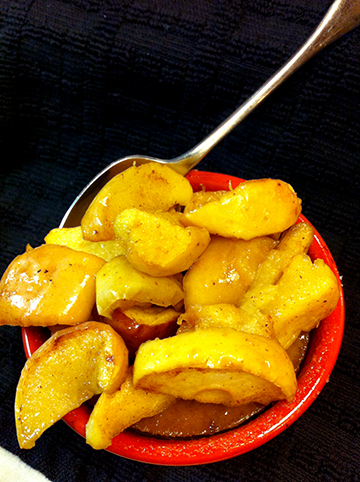
Today's recipe also uses the last of the Gravenstein apples. I roasted them with just a sprinkle of cinnamon and drizzle of maple syrup. The roasting intensified their flavors and softened them, too.


I love pumpkin pie but decided to just do the filling part and bake it in small ramekins in a water bath to keep the texture nice and creamy. I used non-gat evaporated milk and reduced the sugar, plus I used brown sugar. The spices were the same as usual but I used egg substitute and that canned pumpkin, so the final pudding was surprisingly healthy and quite delicious. With a good sized scoop of warm roasted apples on top of the chilled puddings it was like eating the essence of fall. Sweetie wanted some whipped cream on his but mine was without and I enjoyed it just the way it was.


This recipe goes together quickly, although you do need to allow time for the puddings to chill. You can roast the apples while the pudding chills, or you can do it the day before like I did and reheat the apples at serving time. Since the apples don't need to be peeled, they go pretty quickly, too. Imagine how delighted your family or friends will be when you serve up this delicious dessert!

Individual Pumpkin Puddings
1/2 cup dark brown sugar
1 teaspoon ground cinnamon
1/4 teaspoon salt
1/2 teaspoon ground ginger
1/4 teaspoon ground cloves
2 large eggs or equivalent egg substitute (about 1/2 cup)
1 can (15 oz.) canned pumpkin puree', not pumpkin pie mix
1 can (12 fl. oz.) non-fat evaporated milk
cinnamon sugar
boiling water
Roasted apples (see recipe below)
Whipped cream (optional)

Directions
Mix brown sugar, cinnamon, salt, ginger and cloves in small bowl. Beat eggs in large bowl (not necessary with egg substitute). Stir in pumpkin and sugar-spice mixture. Gradually stir in non-fat evaporated milk.

Spray 6 ramekins with baking spray. Sprinkle with cinnamon-sugar (optional). Pour the pumpkin mixture evenly among the ramekins, leaving at least 1/2 inch room at the top.

Place a baking pan with 3 inch high sides which is large enough to hold all the ramekins in the oven. Add boiling water to at least an inch. Carefully place the ramekins in the pan, leaving space between them. Add additional boiling water so that ramekins sides are at least half covered by the water. Bake in preheated 350° F oven for 40-45 minutes or until knife inserted near center comes out clean. Cool on wire rack for 20 minutes, then chill in the refrigerator at least 2 hours or until completely cold.

Remove from the refrigerator and put each ramekin on a small plate. Top generously with the roasted apples. Serve. If desired, top with whipped cream before serving.

Roasted Spiced Apples with Maple Syrup
apples
cinnamon
nutmeg
maple syrup

I didn't have measurements for this recuoe, Cut apples in half and use melon-ball tool to remove the core in each half. Use a sharp knife to remove any stem or blossom end debris. Cut each half in 4-5 wedges and lay, cut side down on a baking sheet lined with baking parchment or a silicon mat. Once all the apples have been placed on the baking sheet, sprinkle with cinnamon and nutmeg. Drizzle with maple syrup. Bake in preheated 400 degree oven for 20-30 minutes or until apples are cooked and edges are beginning to brown. Cool on pan. Remove to a bowl and chill if not serving right away. Reheat if necessary when serving.

Friday, October 26, 2012

Irish Music in West Virginia

Now there is a face that isn't too hard to look at for the better part of four days, right? A dual citizen of Ireland, where he was born, and U.S.A., where he has lived and worked since the late 1960s, Mick Moloney was the one who took a roomful of about 50 men and women on a visual and aural journey to learn about Irish culture and history through music.

I was a Road Scholar neophyte and so was my Mom, but my older sister, who took the great photo of Mick, has been to a few before, so she was our guide in all things Road Scholar. The population of these classes tends to be gray haired but also well read, educated, and often well-traveled.

One of the delights of our time there at the beautiful Cedar Lakes Resort (the large lake is in the photo above) was watching my Mom enjoy meeting and getting to know new people who were invariably kind and interesting folks. No one sent me a personality profile before registering so I don't know how it is that each person we met was someone I wished I'd met sooner. The other great pleasure (well, besides not having to menu plan, cook, clean up, etc for most of 6 days) was getting to spend quality time with my sister and my Mom. Nothing earth-shattering, but some deeper conversations than can usually be had during my flying visits east. A true pleasure in fact.

I wasn't quite sure what to expect from the classes, but was pleased to find that we were given a sort of sampler about various aspects of Irish culture, beginning with a bit about the Celts, about the Irish in Ireland and in America, about the similarities in the experiences of the Irish, Jews and African-Americans of being at the edge of the dominant cultures (which Mick maintains is where artists should be to create great art) and of being looked down on, too, and often abused. He is a skilled and enthralling folklorist so the days just flew. We ended with a little about the current peace between the opposing sides of Ireland and Northern Ireland. Each sampler was illustrated with film and music, some recorded and some live.

Joining Mick was his assistant Joey Abarta, an accomplished young Uilleann pipes player and 'a mighty man', especially with the electronics.

Mick Moloney is a master of banjo, guitar, and (I think) lute or mandolin, plus a delightful singer.
He is also a professor at NYU, an impresario and has recorded many, many CDs. If you want to know more his website is found HERE. He is leading a few tours in Ireland in 2013. Classmates who have toured with him before say that it is a not-to-be-missed experience. Wish I had the funds to join them.

I've often thought that the best thing I learned in college was to always ask more questions and try to find out more. At the end of this set of classes there were many new things learned which led me to want to find out lots more. Now that my cold is starting to retreat I'll have more energy to do just that. Finding the time may be more difficult, but there is no actual rush. Thanks Mick!

So there was plenty of food, cafeteria style food, but with a great salad bar, good conversation, beautiful fall color, a covered bridge (photo below), and lots of great music and information about Ireland and the Irish in America. No cooking, so no recipe this time. But just think, you got a tiny bit of 'culture' this time.

P.S. Thanks sister #1 for many of these photos!

Thursday, October 25, 2012

Another Year

Looks like this blog's birthday passed by while I was traveling. Heading into the seventh year...what an exhilerating time it's been!

The early years included more community with other bloggers, especially when I was part of the Daring Bakers enormous group. At that time I went through a heavy sweets phase, learned lots of new techniques and tried new recipes, for fancy desserts especially.

Once I discovered sourdough the bread phase began and it is still going, but not as strongly. The Bread Bakers Dog is gone and so is the dog it was named for. Our new dog, Pi, isn't given 'people food' so there is no begging when we sit down to eat...a nice change.

These days I spend less time visiting other blogs or even surfing the Internet. Since starting my page layout and design for books business I seem to have less time for other forms of computer fun. My cookbook, Classic Comfort Food, continues to sell on Blurb's site. It would be a great Christmas gift for friends who love to cook! If you want to order a copy or two, just click on the photo of the cover at the top right of this blog...you will go right to the sales page and in no time could have your own copy!

The Bread Baking Babes posts are still a monthly source of fun and learning, but I'm also experimenting more with savory dishes, especially ones that have healthy ingredients. It's a whole new world with things I haven't tried like Isreal couscous, dinosaur kale, quinoa and more.

Hope you'll keep stopping by to see what's new on the journey. Here's to another six or seven years! Cheers!

Wednesday, October 24, 2012

Pesto Rose at Last


Have just returned from a wonderful trip to the East coast. It was so enjoyable seeing family and then seeing fall color on the trip to West Virginia. Loved the class on Irish culture at Cedar Lakes in Ripley and met so many delightful people and heard lots of great Irish music. The drive home via a different route was magical, full of more autumn shades of red, gold, burgundy and rust as the hardwoods welcomed the cold nights. Photo above is of Seneca Rocks, taken along the way by my talented sister. (I'll be posting more about the trip in future posts.) The only fly in the ointment is that I also came home with a cold, so will be spending time in bed that I'd wanted to spend at the computer.

Before I fall asleep again, here is the late-in-posting, but delicious Pesto Rose bread. Last week many Bread Baking Babes posted their version of this Caucasian Rose bread.

Hope you had time to check them out, but, if not, the links are to the right. Our kitchen of the month was the delightful Tanna of My Kitchen in Half Cups. She is enjoying trying new ways to shape bread. This one sounds difficult, but is actually easy.

You are going to want to bake this bread! I know it looks complicated, but it really isn't. If you can roll out a pie crust, you are 1/3 of the way there. If you can roll up dough to make pinwheel cookies or cinnamon rolls, you are the second 1/3 along, if you can braid hair you will have no trouble with the final part of the recipe. See, you can do it.


Find a place to roll out the dough where you can roll it waaaay out. Smear all except the outside inch of dough with pesto. Roll it up like a jelly roll/pinwheel cookies/cinnamon rolls into a nice long log. Pinch the edges and ends (the parts without the pesto on them) to keep that luscious pesto inside.

Now for the fun part! Take a sharp knife and slice down the log, like you would to tuck cheese into a slit in a hot dog...only slice the log in half. The two sides will sort of fall to the sides with the pesto insides showing. Pick up one side and cross it over the other to make a big 'X'.

Then, it is just like braiding with two strands: lift and cross, lift and cross, lift and cross until you get to one end. Tuck the ends under. Go to the other end, life and cross, lift and cross until you get to the other end. Tuck the ends under.

Make a snail of the braided log. Plop the snail into a springform pan. Now it is just the usual rising and baking. The nest to best part? Your kitchen smells heavenly of pesto and you'll get to eat a luscious bread. The best part? Everyone will be SOOO impressed...and will want a piece.

Now you want to make this bread, right? You can also use another filling...cinnamon and sugar, Nutella, apricot jam and ground almonds...you get the idea. Here is what I did:


Pesto Rose
Adapted from http://www.thefreshloaf.com/node/19320/caucasian-bread
Yield: 1 loaf - shown above unbaked, right before it went into the springform ring.

Ingredients:
Filling - 1 cup fresh pesto using basil from my garden.

Dough:
200 grams bread flour
200 grams whole wheat flour
200 grams all-purpose flour, unbleached
2.25 teaspoons dry yeast (Fresh Yeast 28g (1oz)
10 grams Sugar 10g (0.35oz)
10 grams Salt 10g (0.35oz)
50 grams Olive Oil 50cc (1.7 fl oz)
300 grams Water 300cc (10 fl oz) this is approximate

Note: I added almost an additional 1/2 cup water, a tablespoon at a time

Directions:

1. Set oven to 210c (410F) Prep: Baking Pan - 26cm (10") springform (no bottom), take a piece of parchment paper and crimp tightly around the bottom of the springform, oil the sides. Place on top of a baking sheet. Set aside. Note: I placed the springform pan directly onto a Silpat lined, rimmed sheet pan.

2. Add all ingredients to a mixing bowl, add the water carefully as you start mixing. Use the dough hook 2-3 mins. on low speed and 2-3 mins. on medium speed. Dough should be supple and not sticky to the touch. Add water or flour if dough is too stiff or too loose (respectively). When dough is ready, spray a bowl with oil and gently put the dough in the bowl. Spray a little more oil on top and cover. Let rise (80%) about 40 minutes to an hour.

3. Lightly flour your work area. Flatten the dough gently with your hands.
Roll the dough as thin as you can using a floured rolling pin.
When rolling out the dough, try not to lift and move it too much. You can try and gently pull the dough to stretch it thin like with Strudel.

Note: I used the largest bread board I have and rolled the dough out to the edges.

Apply a thin layer of your filling on top of the dough (leave the edge clear 1/4").
Slowly, tightly and very gently roll the dough into a roulade (pinwheel ). You will now have a very long roulade.

4. Take a sharp chef's knife (not a serrated knife) and cut (not saw) the roulade lengthwise trying to keep the knife in the middle so you end up with two equal parts (you can cut down from the seam but it is not make or break).

5. Place the two halves crossing each other (open roulade layers facing up) to create an X shape. Gently pick up the two ends of the bottom half, cross them over the top half, and place them back down. Continue this process, taking the two bottom ends and crossing them over the top until all the roulade has been used. This taking up and crossing is just like a three strand braid, except there are only two strands to cross.

6. You now have a two strand rope shape. If for some reason some of the open roulade layers are pointing down or sideways, carefully turn them so they are facing up. Gently pinch the ends to seal. Look at the braid. If one end looks a little thinner make that your starting point. If not, just start from either end. Slowly and very gently, roll the braid sideways (horizontally) without lifting your hands from the table. You should keep those open roulade layers facing up. Pinch the end delicately. The end result should look like a giant snail shell or a very large cinnamon bun.

7. Carefully pick up the braid and place in the prepared springform. Keep it flat on the parchment. The bottom of the braid should set nicely. Cover. Let rise until the braid hits three quarters the way up the springform. Depending upon the temp in your kitchen this may take from 20 to 40 minutes.

8. Bake at 210c (410F) for 5-10 mins., lower oven to 180c (355F) and bake for another 20-30 mins.

There should be a decent amount of oven spring. The bread should rise above the springform edge.
When the bread is out of the oven lightly brush olive oil or butter on top and sides.

Note: I omitted any extra oil...the pesto had enough.

Let cool on a rack.

9. Elle's changes: I used 200 grams each all-purpose flour, whole wheat flour and bread flour, weighed with the digital kitchen scale. I used a full packet of dry yeast, adding it to 1/4 cup of the water to 'bloom' before adding the rest of the water to it then adding dry ingredients to the wet (which is how I prefer to work), using the stand mixer to mix and knead. I did need to add a little less than 1/2 cup more water to make a nice dough. Used olive oil instead of canola oil. Did not wrap springform in parchment; put the springform ring onto a small rimmed cookie sheet that had a silicon mat on the bottom. That worked well. The oil did seep out during baking, but then was soaked up again into the loaf. Did not use anything other than fresh pesto for the filling; no butter, extra Parmesan, etc. Really didn't need anything else. Did not brush baked loaf with anything...it was plenty oily. Also didn't sprinkle anything over the snail-rolled roll. It was excellent and made a nice base for chopped up tomatoes, too.

Now we know you are going to bake this bread, so why not be a Bread Baking Buddy, too? Send Tanna an e-mail with a photo, link and your baking experience so she can send you a Buddy Badge for your post. Thanks, Tanna for a great recipe! Also, don't forget to visit the other Bread Baking Babes (links on the sidebar) to see their beautiful roses. Au revoir mes amis.

Here is what Tanna gave us to work from:
Recipe Caucasian Rose By: Adapted from http://www.thefreshloaf.com/node/19320/caucasian-bread

Yield: 1 loaf - shown above unbaked, right before it went into the springform ring.

Ingredients:
Filling - the options are only limited by your imagination and what's in your kitchen!

butter , softened
garlic, pressed
parmesan, finely grated
salt , to taste
rosemary or basil

Dough

300 grams bread flour
200 grams white whole wheat flour
100 grams sprouted wheat flour
considering different flour to replace some of above
2-3 tablespoons ground flax seeds or wheat germ or a combo
2.25 teaspoons dry yeast (Fresh Yeast 28g (1oz)
10 grams Sugar 10g (0.35oz)
10 grams Salt 10g (0.35oz)
50 grams Canola Oil 50cc (1.7 fl oz)
considering replacing canola with olive oil & part butter
1 tablespoon White Vinegar 1 tbls, where is this used???
300 grams Water 300cc (10 fl oz) this is approximate
will use some potato water as part of above water

Original recipe called for

AP Flour 600g (21oz) total

seasoning was pesto, dusted with sumac

Directions:

1. Set oven to 210c (410F) Prep: Baking Pan - 26cm (10") springform (no bottom), take a piece of parchment paper and crimp tightly around the bottom of the springform, oil the sides. Place on top of a baking sheet. Set aside.


2. Add all ingredients to a mixing bowl, add the water carefully as you start mixing. Use the dough hook 2-3 mins. on low speed and 2-3 mins. on medium speed. Dough should be supple and not sticky to the touch. Add water or flour if dough is too stiff or too loose (respectively). When dough is ready, spray a bowl with oil and gently put the dough in the bowl. Spray a little more oil on top and cover. Let rise (80%) about 40 minutes to an hour.

3. Lightly flour your work area. Flatten the dough gently with your hands.
Roll the dough as thin as you can using a floured rolling pin.
When rolling out the dough, try not to lift and move it too much. You can try and gently pull the dough to stretch it thin like with Strudel.

Apply a thin layer of your filling on top of the dough (leave the edge clear 1/4").

Slowly, tightly and very gently roll the dough into a roulade (pinwheel ). You will now have a very long roulade.

4. Take a sharp chef's knife (not a serrated knife) and cut (not saw) the roulade lengthwise trying to keep the knife in the middle so you end up with two equal parts (you can cut down from the seam but it is not make or break).

5. Place the two halves crossing each other (open roulade layers facing up) to create an X shape. Gently pick up the two ends of the bottom half, cross them over the top half, and place them back down. Continue this process, taking the two bottom ends and crossing them over the top until all the roulade has been used. This taking up and crossing is just like a three strand braid, except there are only two strands to cross.

6. You now have a two strand rope shape. If for some reason some of the open roulade layers are pointing down or sideways, carefully turn them so they are facing up. Gently pinch the ends to seal. Look at the braid. If one end looks a little thinner make that your starting point. If not, just start from either end. Slowly and very gently, roll the braid sideways (horizontally) without lifting your hands from the table. You should keep those open roulade layers facing up. Pinch the end delicately. The end result should look like a giant snail shell or a very large cinnamon bun.

Depending on your filling you may want to sprinkle on something (paprika, sumac, brown sugar & cinnamon). Keep in mind you don't want to cover up the effect of the shaping.

7. Carefully pick up the braid and place in the prepared springform. Keep it flat on the parchment. The bottom of the braid should set nicely. Cover. Let rise until the braid hits three quarters the way up the springform. Depending upon the temp in your kitchen this may take from 20 to 40 minutes.

8. Bake at 210c (410F) for 5-10 mins.,

lower oven to 180c (355F) and bake for another 20-30 mins.
There should be a decent amount of oven spring. The bread should rise above the springform edge.
When the bread is out of the oven lightly brush olive oil or butter on top and sides.
Let cool on a rack.


ORIGINAL RECIPE
Caucasian Bread - Julia's Rose
Recipe By: http://www.thefreshloaf.com/node/19320/caucasian-bread
Yield: 1 loaf

Summary: This beautiful braided bread is made with a rich straight dough, layers of pesto and a generous sprinkle of Sumac.

I made this bread a couple of months ago. This bread is tender, rich, nutty, salty (evoo, toasted pine nuts and parmesan) and a little sour (Sumac). This bread requires moderate braiding skills, time and attention.

I have been baking for quite some time now. I love bread making.

Ingredients:
Pesto - I use evoo, basil, toasted pine nuts, parmesan (consistency should be not too thin and not too thick). Keep refrigerated until needed.
Sumac - for sprinkling

Dough ingredients:
AP Flour 600g (21oz)
Fresh Yeast 28g (1oz)
Sugar 10g (0.35oz)
Salt 10g (0.35oz)
Canola Oil 50cc (1.7 fl oz)
White Vinegar 1 tbls
Water 300cc (10 fl oz) this is approximate

Directions:

1. Set oven to 210c (410F) Prep: Baking Pan - 26cm (10") springform (no bottom), take a piece of parchment paper and crimp tightly around the bottom of the springform, oil the sides. Place on top of a baking sheet. Set aside.

2. Add all ingredients to a mixing bowl, add the water carefully as you start mixing. Use the dough hook 2-3 mins. on low speed and 2-3 mins. on medium speed. Dough should be supple and not sticky to the touch. Add water or flour if dough is too stiff or too loose (respectively). When dough is ready, spray a bowl with oil and gently put the dough in the bowl. Spray a little more oil on top and cover. Let rise (80%). My kitchen was at about 22c (72F), 35-45% humidity and proofing was about 40 minutes. Lightly flour a work bench or a large table. Put the dough on top and flatten gently with your hands. Use a floured rolling pin to roll out the dough to a very thin circle, as thin as you can. When rolling out the dough, try not to lift and move it too much. You can try and gently pull the dough to stretch it thin (like bakers do with Strudel dough), this requires some skill. Apply a thin layer of pesto on top of the dough (leave the edge clear 1/4"). Sprinkle Sumac generously on top of the layer of pesto. Slowly, tightly and very gently roll the dough into a roulade (pinwheel ). You will now have a very long roulade . Take a sharp chef's knife (not a serrated knife) and cut (not saw) the roulade lengthwise trying to keep the knife in the middle so you end up with two equal parts (you can cut down from the seam but it is not make or break). Place the two halves crossing each other (open roulade layers facing up) to create and X shape. Gently pick up the two ends of the bottom half, cross them over the top half, and place them back down. Continue this process, taking the two bottom ends and crossing them over the top until all the roulade has been used. You now have a two strand rope shape. If for some reason some of the open roulade layers are pointing down or sideways, carefully turn them so they are facing up. Gently pinch the ends to seal. Look at the braid. If one end looks a little thinner make that your starting point. If not, just start from either end. Slowly and very gently, roll the braid sideways (horizontally) without lifting your hands from the table. You should keep those open roulade layers facing up. Pinch the end delicately. The end result should look like a giant snail shell or a very large cinnamon bun. Lightly sprinkle Sumac on top of the braided loaf. Carefully pick up the braid and place in the prepared springform. Keep it flat on the parchment. The bottom of the braid should set nicely. Cover. Let rise until the braid hits three quarters the way up the springform. In my kitchen conditions it proofed for a little over 30 mins.

3. Bake at 210c (410F) for 5-10 mins., lower oven to 180c (355F) and bake for another 20-30 mins. Their should be a decent amount of oven spring. The bread should rise above the springform edge. When the bread is out of the oven lightly brush evoo on top and sides. Let cool on a rack.

Friday, October 12, 2012

Fall Fling

Not sure why but October and May seem to be the months when wanderlust really hits. Since it has been a while since I've seen the fall color on the east coast, I'm leaving Sweetie and Pi for a few days to visit with my Mom and other family members and get my fall color fix. Won't be doing much blogging while I'm gone but I'm sure to have some stories when I get back. Hope you have some good times in the kitchen until then!

Here is some fall color nearer to home, at the place where we like to walk the dog. Those are wild grape leaves...very colorful!

XO Elle.

Sunday, October 07, 2012

At Gabriel Farm

It all started with an apple, as some very interesting stories do. Of course I was so fascinated with what I was learning that I forgot to take any apple photos, but the story is good enough.

My friend Arcadia heard from a friend that there was a stupendous yellow apple called the Gabriel Apple that was grown in nearby Graton and she was told that she should go to the farm and try it out. Since she knows of my interest in fancy food, she sent me a link to Gabriel Farm and suggested a day trip. When I visited the site I became excited, not because of the apple, but because they were harvesting Asian pears, one of Sweetie's favorite snacks. They also have an Asian pear and apple juice that looked mighty good.

 Turns out that juice is amazingly good, the Asian pears are the best he has ever had, and the farm visit was a hit...


And so, a couple of weeks ago, Arcadia and I had a farm visit day. I had planned to blog about it much sooner but life has been super busy with all manner of good things. I had hoped to blog about a recipe of something made with some of the Asian pears but they were all eaten for snacks, with great gusto.

Gabriel Farm has been around for a long time. The original family was named Gabriel and they developed a yellow apple called the Gabriel apple (more on that later), but the current owner is a former science teacher named Torrey.

He and his wife run the farm and do both wholesale and farmers markets, plus school kids love to visit the farm. There was a group of them finishing up, buying some things from the farm store,

 when we arrived. Torrey is a natural teacher and imparts a lot of information in a gentle, easy to understand way. Thanks to him I now know how many seeds you'll find in almost all apples...ten...and that if you slice an apple horizontally those seed form a sort of flower shape. The Gabriel apple is a descendent of a sport found in the middle of an old apple grove in Missouri that had been planted by Johnny Appleseed. Apple growers came from all over to purchase scions of that apple to graft onto their own trees. The Gabriel apple is the product of one of those grafts and, perhaps, some cross-pollination. A good apple like the Gabriel has layers of flavor when you eat it, sort of like the layers of flavor in a fine wine. They have many more apples besides the Gabriel and all are farmed organically like the Asian pears.

Before you get the idea that you can just wander over and have a farm tour, let me explain that since it is a working farm, that just isn't possible. I exchanged a number of e-mails to arrange for a time and also became a CSA member by purchasing a case of that fabulous Asian pear-apple juice...no hardship there. Members can have a farm tour if a time can be arranged.

We did notice how busy the workers were with sorting, packing, and moving cases of Asian pears around using a forklift, getting them ready to ship.

When you walk through the rows and row and rows of fruit trees and learn that they have over 20 varieties of Asian pears growing there, it is easy to see that there is little time for too many tours.


The Asian pears are really beautiful on the tree and you can see that some are bright gold, ready to pick, and some are still greenish.

Torrey said that one of the reasons Asian pears cost a bit more is that they bruise easily but also that they need to be picked three or four times as they ripen, adding to labor costs.

 I loved how they were planted in blocks and he said that Asian pears self-pollinate and that the pollen is very fine and light so having the trees grouped makes sense.

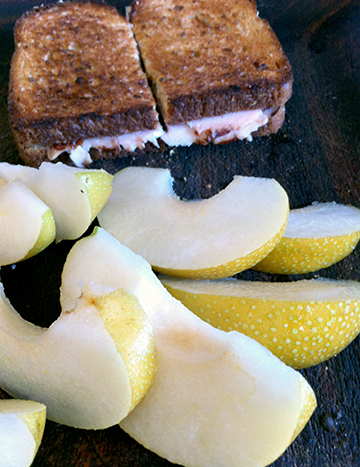
Knowing my Sweetie, I chose a russet Asian pear to bring home. It was crisp, sweet, very juicy and not as gritty in texture as some you find in the stores. I cut one up as soon as I got home and he munched right through it in no time. So, no recipe, but there is a photo of the gorgeous Asian pear (above) and of the jar (even further above) of juice. Here is the one I cut up for Sweetie to go with his sandwich.

You may want to ask your grocer (if you live in the S.F. Bay area especially) to carry some of these Asian pears, apples and juice. It might not be as fun as a farm visit, but it could be a great way to have some of this locally sourced and amazing fruit and juice yourself. You can also check out the website at: http://gabrielfarm.com/portal/home


By the way, I'm not receiving any benefits from doing this post...I already had the pleasure of that tour which was a treasure in itself.

Sunday, September 30, 2012

September Zipped By


Some months seem to drag...like August does for me. Some just fly by. September did that this year. Between being careful of the arm, doing the InDesign class and homework,  and having a couple of weeks at the end which were full of social occasions, it just blew through, with not enough time to blog much. I noticed that there was nothing posted this month in the way of sweets, so let's end with an update on an old cookie.

Saucepan Fruit Bars has been a family favorite for many, many years. It is easy, mixed in a saucepan, uses buttermilk, has dried fruit, a dense crumb, and a zingy lemon glaze to wake up the fairly plain cookie.

Spicy Updated Saucepan Fruit Bars keeps all of the above but subs out some all-purpose flour for whole wheat flour, adds finely chopped walnuts and a dose of chocolate chips and increases the spice a bit. The texture is still dense and a bit dry and it still needs the lemon glaze but it is much more complex in flavor and quite delicious with a cup of tea or coffee.

Remember this one when you need a quick pan of bar cookies, need to ship cookies to servicemen or students or your favorite friend who lives far away. These cookies are speedy to put together and travel well, too. I think they are really yummy, too, so you just might want to invite a neaby friend or neighbor over for an afternoon cuppa and these cookies.

Spicy Updated Saucepan Fruit Bars

1 cup butter, melted

3/4 cup brown sugar
3/4 cup sugar
2 eggs
2 cups all-purpose flour, sifted
1 cup whole wheat flour
½ teaspoon baking soda
½ teaspoon salt
1 teaspoon each nutmeg, cinnamon, and cloves
¼ cup buttermilk
½ cup golden or brown raisins
½ cup dried currants
½ cup finely chopped walnuts
½ cup chocolate chips

Melt butter in saucepan. Add sugars and stir to combine. Cool mixture, then add the eggs; beat well. Add sifted dry ingredients, spices, and buttermilk and mix well. Stir in fruit, walnuts and chocolate chips. Spread in greased 15” x 1O” x 1” pan. Bake in a 350 degree F. oven for 25 minutes. Brush with glaze (see below) while hot; cool in pan. Cut into 2” x 1” bars. Makes 45 cookies.

Glaze: Mix 1 cup confectioners sugar and 4 teaspoons fresh lemon juice.

Wednesday, September 26, 2012

Late Rye Bread Worth the Wait

This lovely Rye Bread that has nostalgic meaning for Kitchen of the Month Elizabeth requires kneading and this month when the Bread Baking Babes...and many Buddies...posted their versions, I was still letting the old arm heal, so no kneading allowed.

Now we are into the 6th week post-injury and I'm supposed to start using it more, so I HAD to make the Fennel Molasses Rye Bread as part of my rehab :)

I'm not a huge fan of fennel or even caraway, so I added some pulverized dried orange peel instead. The molasses gives the bread a fantastic flavor. I used mild, not blackstrap, but it worked just fine. For the raisins I used golden raisins because thats what I had on hand. The dough is lovely and easy to work with. I decided to make rolls and they are extremely delicious!

This recipe is a keeper for sure. Thank you Elizabeth! I know I'm late to the BBB party, but it was worth the wait.

Molasses Fennel Rye Bread

based on Jack Francis' recipe for Molasses-Fennel Bread served at "Clark's by the Bay" restaurant in Collins Bay, Ontario (near Kingston) - now sadly closed
makes two round loaves (or 8 large rolls)

¼ c (63gm) lukewarm water
1½ tsp ( 6 5gm) active dry yeast
4 tsp (17gm) sugar
4 Tbsp (85gm) blackstrap molasses
1¾ c (438gm) water, room temperature
1 Tbsp (6gm) fennel seeds
½ tsp (1gm) ground dried ginger
1 c (103gm) rye flour
1 c (122 gm) whole wheat flour
½ c (59gm) wheat germ
2 c (254gm) unbleached all purpose flour
1 Tbsp (18gm) salt
¼ c (36gm) Thompson raisins
up to ½ c (64gm) unbleached all purpose flour for kneading

Mixing In a smallish bowl, whisk yeast with the lukewarm water (do the baby's bottle test on your wrist) until it resembles cream. Set aside.

Meanwhile, in a bowl large enough for the dough to double, pour the rest of the water. Stir in sugar and molasses. (If the molasses is stiff because of a chilly kitchen, use warm water instead of room temperature.) Add fennel seeds and ground ginger. Dump in flours, wheat germ and salt and stir with a wooden spoon until the flour is mostly absorbed.

Add the yeast mixture (it should be quite foamy - if it is not after a period of 20 minutes have passed, either the yeast is dead or the water was too hot or far too cold. Check the due date on your yeast container. If the date hasn't passed, try again.) stir to form a rough dough. Cover the bowl with a plate and let sit on the counter for about 20 minutes.

Kneading Scatter a little of the flour for kneading onto a wooden board. Turn the dough out onto the board.

Wash and dry the mixing bowl. (Please do not be tempted to skip this step.)

Hand knead the dough 10 to 15 minutes, adding the smallest amounts of additional flour if dough is sticky. You don't have to use up all the flour. When the dough is springy and silky to the touch, knead in raisins.

Proofing Form the dough into a ball and put it in the clean bowl; cover it with a plate (there is no need to oil the bowl!) Let the dough rise in a no-draught place at room temperature (or in the oven with only the light turned on if you want) for about an hour or until it has doubled in size. Gently deflate dough. Recover with the plate and allow to rise until doubled again.

Gently turn the dough out onto a lightly floured board; cut it in half with a dough scraper if you have one, with a knife if you don't.

Shape into two round balls and place them (not touching) on a parchment papered pan or a cornmeal dusted peel. Dust the tops with flour. Cover with a clean tea towel followed by a large plastic bag overtop let rise until double in size. (about an hour if the temperature is around 20C)

Baking Place a breadstone, if you have one, on the middle to second from the top rack and preheat the oven to 400F.

If you want, slash the top of the rounds with a very sharp knife. Liberally spray the tops with water. Put bread in oven and immediately turn the oven down to 350F. Bake the bread on the middle to second from the top rack for 35-40 (I bake it for 45 50- 30-35) minutes until the bread reaches an internal temperature of 205-210F or until it is hollow sounding on the bottom. It's a good idea to turn the bread after about 20 minutes of half way through baking to allow for uneven heat in the oven (remove parchment paper at the same time).

Remove to cool on racks. Please wait until the bread is cool before cutting it. It's still baking inside! If you like to eat warm bread, reheat the bread after it has cooled.

 
We enjoyed these rolls with some butter, barely cooled from baking, then again this morning for breakfast. Awesome!

Monday, September 24, 2012

Beans Redux


Seems to take forever to actually get a post up these days. This bean dish was enjoyed last Thursday for my dinner before my InDesign class. It's starting to get exciting as I see new ways to do the book I'm working on, especially now that I have colors picked out and have collected a lot of the photos I'll be using. I tried out at least 6 cover ideas and I'm still not sure I have the right one, but at least I'm in the neighborhood, so to speak.

Anyhoo, the beans used in this recipe are the rest of the beans I cooked up for the Baked Beans. There is something very satisfying about a combination of beans and greens. It was a time saver that I could walk out the door and harvest four varieties of Swiss chard for the greens part and you can't get much fresher than that. I used the stems, too, which is what look a bit like red pepper in the photos. I would usually add garlic to this dish, cooking some minced garlic with the onions after the onions had cooked about half way, but since I was going to class I decided to just go with the onions. I still used some breath mints right before class. Onions are a bit smelly, too!

Feel free to add additional herbs, sausage or seitan, a can or helping of another kind of bean to make these even more interesting. Then dig in and have a nice, filling meal. Some whole grain bread would be great with this dish, too.


Beans and Greens

2 cups cooked beans...I used the Vallarta beans from the recipe in THIS post
1-2 tablespoons olive or grapeseed oil
1/2 yellow onion, chopped

1 large bunch greens, rinsed, large ribs removed, and washed well (I used chard but you could use kale, spinach, young collards, etc. instead)
1 tablespoon fresh flat-leaf parsley, chopped
Salt & pepper to taste
Balsamic vinegar to taste

Reheat the beans in the microwave or in a pot on the stove.

While beans are reheating heat the oil in a medium sized pot, then sautee' the onion, stirring often, until the onion is transluscent are lightly brown, about 5-8 minutes. Add the prepared greens and stir to coat with the onions. Cover, reduce the heat to medium, and let cook for 2 minutes. Uncover, stir, and continue stirring until greens are limp. Add the heated beans and any bean liquid, parsley, salt and pepper. I also like a splash of balsamic vinegar with these.

Serve at once. If desired, sprinkle with more chopped parsley.
Serves 1-2

Wednesday, September 19, 2012

Awesome Baked Beans

Last May my older sister came to visit and at one of the stores in town we visited they were selling one pound sacks of unusual, heirloom dry beans from Rancho Gordo. I chose to try Vallarta They are described in the book from Rancho Gordo, Heirloom Beans, as a, "dense, soft yellow bean" and as being very rich and often paired with other ingredients, including greens like spinach, kale and chard.

I wish I could say that I tried them immediately and have since become someone who eats heirloom beans once a week or something, but the truth is that it took me until this week to cook them up and try them. Since they sounded like a bean that would taste good baked, I used two cups of the cooked beans to make some baked beans to go with fresh, roasted beets,

capresi salad with heirloom tomatoes, basil and fresh mozarella, plus some leftover meatballs from Costco and a plate of sliced cucumbers. everything except the cheese, meatballs and beans came from the garden and it was a satisfying meal. The beans were so rich that I ended up only eating one meatball and one slice of the cheese in the salad. Next time I'll serve the beans as a main course and forget about any meat. They really don't need it.

This is a pretty simple baked bean dish. If you don't have any freshly cooked beans on hand, you could substitute white beans or pinto beans from a can and still have a nice dish. Adjust the amount of molasses to suit your own taste. Some kinds are more potent than others and some people are fonder of molasses, too. Sweetie loves molasses and really like these beans. I didn't look at any recipes, just threw together things that seemed like they would make a nice pot of baked beans.

Baked Beans

2 cups cooked beans (I used Vallarta beans from Rancho Gordo). Recipe for cooking beans below.
2 teaspoons Dijon mustard
1/2 medium onion, finely chopped
1-2 tablespoons molasses
2 tablespoons ketchup
salt and pepper to taste

Combine beans and next four ingredients in an oven proof bowl or casserole. Taste for seasonings and add salt, pepper, and more molasses to taste.

Bake in a preheated 350 degree oven, uncovered, for 20-30 minutes. Beans will be cooked through and crusty on top like the phot at the beginning of this post. Serve at once. Serves 2-4.

Cooking Dry Beans
I used a pound bag of beans and have enough left over after using 2 cups, cooked, for the baked beans that I can make another recipe. The instructions work for larger or smaller quantities of beans, but as long as you are taking the time to cook the dry beans, why not do at least a pound?

Pour the dry beans into a collander and rinse, making sure to check for any debris, small pebbles, etc. I didn't find any in my packet of beans, but have found some before when cooking lentils, so I always look. Place the rinsed beans in a large bowl and cover with cold or room temperature water. Let beans soak at least 3 hour, up to overnight. When ready to cook the beans, I poured out the soaking water and rinsed them again and set them aside. Some folks just put the beans, soaking water and all into the pot after they have cooked the mirepoix.

In the pot you will be cooking the beans, saute' a mixture of finely chopped onion, carrots and celery in a bit of bacon grease or olive oil or grapeseed oil. For the pound of beans I used 1/2 and onion, about 1/2 cup carrots and 2 stalks celery. This is the mirepoix.

To the mirepoix, once it is cooked long enough to color the carrots and so the onion is translucent, add the beans and stir to combine. Cover with water and enough extra water to be one inch over the beans. Bring to a boil, uncovered, and boil 5 minutes. Reduce the heat to a simmer, stirring often, let beans simmer until tender, somewhere between 1 and 4 hours, depending on the age of the bean and how it has been stored. When the beans are almost ready they really have a nice, beany smell which you will notice more than the onion-celery-carrot smell. Keep an eye on the liquid and add more room temperature water as needed. When the beans were almost tender I let some of the liquid cook down, so by the time they were done there was about 1/4 inch of beans above the bean cooking liquid. I also stirred the beans a lot to make sure that they cooked evenly.

Your beans are now ready to use in any recipe calling for cooked beans. Think of all the stews, chilies, soups, salads and so on that you can make. The Vallarta beans have even been used as ravioli stuffing, according to Steve Sando, one of the authors of Heirloom Beans. You can find Rancho Gordo beans and the book on the web, too.

Tuesday, September 11, 2012

Harvest

It begins in the chill of winter when I start the seeds germinating in the sunspace, continues with the planting of the sprouted seeds in the cell packs of soil, brings joy as the seedlings appear and grow even though it is still early spring and chilly outside. Eventually the seedlings get re-planted into bigger peat pots filled with more potting soil, are set out to harden off. The big day comes and the seedlings get planted in the garden, both in the soil, protected by gopher baskets, and in pots and half barrels of potting soil. Drip irrigation gets set up and tested and fixed where there are problems. Plants outside the irrigation system area get watered daily. In time fertilizer is applied, seedlings thinned where needed, plants caged or tied up as they grow taller.

 Flowering happens and in time 'fruit' is set and the beans, peas, cucumbers, tomatoes, squash veggies get bigger day by day. The beets underground do, too. The chard and lettuce get leafier and leafier. The harvest for beans, peas, chard and lettuce is pretty quick and the zucchini also is ready to pick mere days after the blossom is set, but the beets and cucumbers take a while and the tomatoes take a long, long time. It really feels like harvest time when the tomatoes are ripe!

That time has come and we are really enjoying it. Fresh Black Krim, sliced, lightly sprinkled with salt and pepper, drizzled with olive oil and balsamic vinegar, it doesn't get much better than that. Fresh tomatoes have been going into salads, sandwiches, crostini spreads, chili, soups and more. The latest is a pasta 'sauce' of roasted Yellow Brandywine tomatoes and a few Russian Plums. They were drizzled with some olive oil before roasting and later tossed with some ground turkey that I had browned with a bit of onion. Parmesan cheese and chopped fresh basil was tossed in with the hot pasta. Sooo good! No recipe needed, right?

BTW the elbow wasn't broken, ligaments weren't torn, but muscle was, so left arm is getting lots of rest and right arm is getting a workout. PT coming up soon, too. Sweetie has been a champ through it all and continues to do things that are difficult, like fastening my seatbelt.

Time has also been taken up of late with a new InDesign class. We are doing a book for the class. If you look at the top right of this blog you'll see that I've done that...a cookbook in fact...but now I'm going to learn how to do even more. Expect another book to show up around Christmas. It is a lot of work, but tons of fun, too! Almost as much fun as harvest.

Saturday, September 01, 2012

Roasted Veg Focaccia and Bum Arm


It's been quiet here at FME lately. one reason has been the delightful visit of Captain Jack and the Birthday Girl, but there is also the unfortunate matter of the bum arm. Have gotten moderately good at typing with only my right hand because a combination of accidents (apparently now insurance companies no longer call them injuries...they are accidents) starting with too tight a grip on an unfamiliar golf club, followed two weeks later with lifting a box which was much heavier than I knew. Had an x-ray yesterday at the hospital. With the Labor Day weekend, it will probably be Tues. before I hear back from the doc. This was a week after the doctor asked me to do a wait and see while resting the arm, which was 4 days after the box related injury, so it will be over two weeks after that I find out if anything is fractured! Guess I should have gone to the ER the day of the injury. Live and learn. Send chocolate!

On a lighter note, before all the serious stuff, I baked King Arthur Flour's Roasted Vegetable Focaccia using squash and grape tomatoes and basil from the garden. It has a lovely crust, a nice light & chewy texture and the veggies were a great topping.

When I make it next time I'm going to add fresh rosemary to the dough and sprinkle Parmesan on top of the veggies to bake on...will probably put the tomatoes on the dough at the same time as the squash, too. Putting them on later meant the slid off the crusted dough instead of sinking in.


Roasted Veg Focacciafrom King Arthur Flour

Starter

1/2 cup cool water
1/16 teaspoon instant yeast
1 cup King Arthur Unbleached All-Purpose Flour

Dough
all of the starter (above)
2 teaspoons instant yeast
1/2 cup lukewarm water*
2 cups King Arthur Unbleached All-Purpose Flour
1 1/4 teaspoons salt
2 tablespoons Baker's Special Dry Milk or nonfat dry milk
2 tablespoons olive oil
*Use 1 tablespoon less water in summer (or in a humid environment), 1 tablespoon more in winter (or in a dry climate).

Topping
3 pounds zucchini, about 6 medium zucchini*
olive oil
Pizza Seasoning, optional
2 bunches scallions, root ends trimmed*
1 pound cherry tomatoes*
shaved Parmesan cheese, optional
*Don't stress over exact amounts here; more or less of any of these ingredients is fine.

1) To make the starter: Mix the water and 1/16 teaspoon yeast, then add the flour, stirring until the flour is incorporated. The starter will be paste-like; it won't form a ball.

2) Cover and let rest at room temperature for about 14 hours; the starter will be bubbly. If you make this in the late afternoon, it'll be ready to go by the next morning.

3) Combine the risen starter with the remaining dough ingredients, and mix and knead — by hand, mixer, or bread machine set on the dough cycle — to make a soft, smooth dough. If you're kneading in a stand mixer, it should take about 7 minutes at second speed.

4) Place the dough in a lightly greased container, cover, and let it rise for 1 hour.

5) Gently deflate the dough, and allow it to rise for another hour; it should have doubled in bulk from its original volume.

6) Sometime during the dough's rise, prepare the vegetables. Trim the zucchini, and slice about 3/4" thick. Toss with olive oil; sprinkle with Pizza Seasoning (or other dried herbs), if desired. Spread the zucchini, in a single layer, on a lightly greased baking sheet.

7) Cut the cherry tomatoes in half. Toss them with olive oil and Pizza Seasoning or dried herbs. Place them, cut-side down, on a lightly greased baking sheet. Cut the scallions into 2" to 3" pieces. Toss in oil, sprinkle with herbs, and place on the baking sheet along with the tomatoes.

8) Place the vegetables in a preheated 400°F oven. Bake the zucchini, turning it over once, until it's golden brown. This will take about 60 minutes. Bake the scallions and tomatoes until they're starting to brown and soften, about 25 to 30 minutes.


9) Remove the vegetables from the oven, use a spatula to gently loosen them from the pan, and set them aside.

10) Lightly grease an 18" x 13" rimmed baking sheet (half-sheet pan) with non-stick vegetable oil spray. Drizzle olive oil atop the spray; the spray keeps the bread from sticking, while the olive oil gives the bottom crust great crunch and flavor.

11) Gently deflate the dough. Pull and shape it into a rough rectangle, and pat it into the pan. As soon as it begins to fight you and shrink back, stop patting. Wait 15 minutes; pat the dough farther towards the edges of the pan. Repeat once more, if necessary, until the dough is close to covering the bottom of the pan.

12) Place the zucchini atop the dough. Cover the pan, and allow the dough to rise until it's very puffy, almost billowy. This will take about 2 to 3 hours. Toward the end of the rising time, preheat the oven to 425°F.

13) Place the pan on a lower rack in your oven, and bake the focaccia for 15 minutes. Remove the pan from the oven, top with the scallions and tomatoes, return to the oven, and bake for an additional 10 minutes, until the crust around the edges (and showing between the vegetables) is golden brown.

14) Remove the focaccia from the oven, and top with Parmesan cheese, if desired.
Yield: one focaccia, 8 to 10 servings.

Notes: I used my sourdough starter instead of the starter in the recipe. I forgot the Parmesan shards.
I didn't have any scallions, so used yellow onion, minced, instead. Still yummy!